Adesso Italia

Enterprise AI

We transform AI prototypes into robust and reliable enterprise agentic applications designed to increase productivity and usability, revolutionising the way business applications are used.

What will you find on the page?

A prototype agent that works well in a controlled environment does not automatically withstand the transition to production: data and variety increase, the non-determinism of the models becomes a risk, exposure of data and computational costs grow, and the proof of concept must integrate with systems it was previously unaware of. adesso.it responds with a method based on four levers, business domain knowledge, system engineering, co-design with users and a three-tier architecture (data, agents, governance) designed to scale the actual load. 

The problem: why an agentic PoC does not scale on its own  
The method: four levers to engineer the solution  
The architecture: data, agents, governance 
The benefits

The problem: Why does a prototype that works in a demo not hold up on its own in production?

THE PROBLEM OF COMPANIES TODAY

The evolution of enterprise software applications means that Artificial Intelligence is no longer just another new feature, but is completely revolutionising the user experience by introducing an “agent layer” that acts as an interface and orchestrator between users, data and applications. The transition from a Software as a Service (SaaS) model to an Agent as a Service (AaaS) architecture represents a major strategic opportunity for companies that need greater flexibility and responsiveness.  

However, the path is difficult. Prototypes based on Artificial Intelligence technologies often demonstrate promising effectiveness in controlled environments. The real challenge arises when attempting to scale these solutions for real-world applications:  

  • The increase in the quantity and variety of information to be managed puts a strain not only on the intrinsic performance of LLMs, which can exhibit increasing latency or inaccuracy, but also on the efficiency of upstream data ingestion and processing architectures.
  • The non-deterministic nature of LLMs introduces an inherent error that, while acceptable in a PoC, becomes critical when it impacts core processes and business decisions. 
  • As the amount of data processed increases, so does the risk of inadvertent exposure of sensitive data or malicious attacks, introducing new security and privacy concerns.  
  • The scalability of AI models leads to an exponential increase in computational costs in terms of GPUs, memory, and computing power.  
  • PoCs often operate in isolation, but scalability requires integration with existing IT infrastructure and business systems, which must be managed.

The method of adesso.it

FROM PROTOTYPES TO ENTERPRISE AGENT APPLICATIONS

Our distinctive value lies in our ability to engineer and transform ideas and prototypes into robust, scalable AI solutions that are integrated into business processes. We do this by following a methodological approach based on two fundamental pillars. 

1. We start from our customers’ business and technological domain. Our unique ability to understand and design evolutions in companies’ application portfolios allows us to go beyond stand-alone innovations and conceive them within the customer’s technical and business ecosystem: 

  • Data: we analyse customers’ various data sources, their structure and quality, to build efficient and reliable ingestion and processing pipelines. 
  • Applications: we understand the architectures of existing systems, ensuring smooth integration and avoiding the creation of technological silos. 
  • Processes: we map the workflows that AI will enhance to ensure that the solution integrates seamlessly and brings real value. 


    2. We engineer robust, flexible and secure solutions. To overcome the intrinsic challenges of AI (non-determinism, costs, security), we apply our working method to guide and contain application behaviour through targeted engineering practices: 
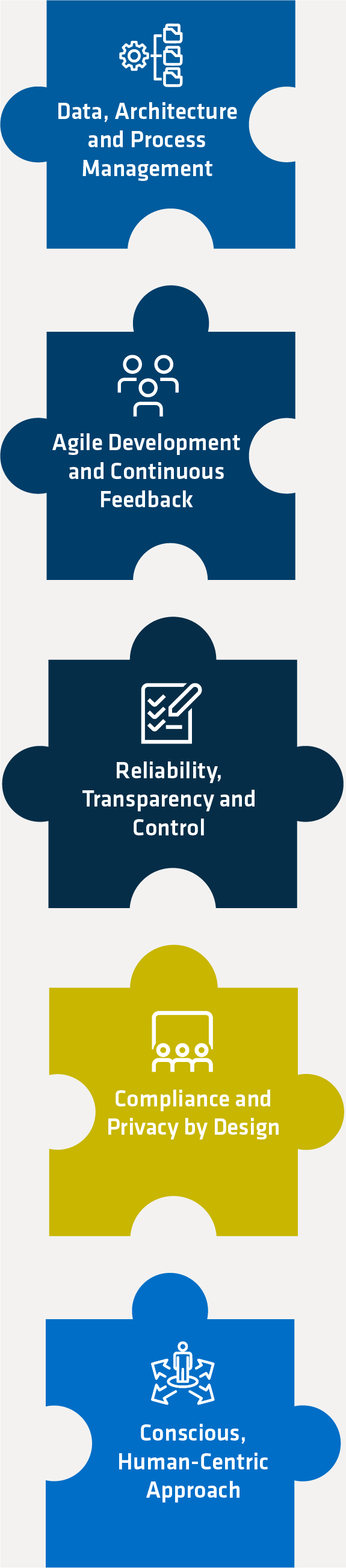
  • Agile development and continuous feedback: we use short iterative cycles (sprints) with frequent demos. This incremental approach allows us to gather constant feedback from stakeholders, quickly correct the course and deliver business value from the earliest stages.
  • Reliability, transparency and control: through an Adaptive Test Driven Development approach, we define objective performance metrics and subject the system to continuous testing to identify and mitigate unexpected behaviour, ensuring consistency of responses. We design systems in which it is always clear when the user is interacting with AI and we provide checkpoints where a human supervisor can validate or correct crucial decisions, ensuring control and accountability. We implement security mechanisms that, in the event of malfunction or abnormal AI responses, ensure service continuity by passing control to predefined logic. 
  • Compliance and Privacy by Design: from the architecture phase onwards, we analyse the constraints (such as GDPR) to which the company is subject, on a case-by-case basis. This analysis guides the choice of tools and platforms to be used, which guarantee the confidentiality of private and confidential information and the protection of intellectual property. 


    3. Conscious and human-centric approach. We adopt a co-design approach that actively involves users and stakeholders in shaping intelligent agents that reflect the real operational, decision-making and relational needs of the context in which they will operate. This approach allows us to integrate artificial intelligence with human intelligence, enhancing critical thinking, contextual intelligence and judgement. Only in this way is it possible to create solutions that are truly scalable in terms of adoption, sustainability and impact on the organisation.

THREE LEVELS TO TAKE AGENTIC AI FROM PROTOTYPE TO PRODUCTION


We don't think of Agentic AI solutions as standalone innovations: we build them within the client's technical and business ecosystem. The solution is structured on three distinct but coordinated levels, each with a reference architecture and the engineering discipline that makes it robust, scalable, and truly integrated. 

1

INFORMATION LEVEL

Domain knowledge as the base   
A Corporate Knowledge Graph models the client's data, applications, and processes as a network of real relationships, making them structured and queryable by agents. We start with the client's real data, applications, and processes, not an abstract model: reliable ingestion pipelines on existing sources, integration without creating new silos, mapping of flows that AI will enhance.

2

APPLICATION LEVEL

Agents that collaborate, people that decide   
A cloud-native multi-agent architecture, where multiple agents collaborate on different stages of the same process, each with a specific and defined responsibility. The design of the agents arises from a human-centric co-design: we involve users and stakeholders to model behaviors that reflect real operational and decision-making needs, integrating artificial intelligence and human judgment instead of replacing it.  

3

GOVERNANCE LEVEL

End-to-end control of the agentic system   
Integration with existing systems, multi-level guardrails, observability, evaluation by design, FinOps. Our working method guides and contains the system’s behavior: Adaptive Test Driven Development, human checkpoints on crucial decisions, compliance, and privacy by design from the architecture itself.

The benefits of Enterprise AI

BENEFITS

Thanks to integration with corporate systems and information storage capabilities, agents are revolutionising the way enterprise applications are used. Business logic is shifting towards a new AI layer capable of interacting directly with corporate data. 
In particular, the benefits can be classified into the following types:

PERSONALISATION OF SOLUTIONS

Thanks to integration with company systems, AI agents can support specific use cases for different industrial sectors and individual companies.

INCREASED BUSINESS PRODUCTIVITY

An AI agent can make decisions based on real-time business data, reducing the number of errors, optimising and speeding up processes.

USABILITY REVOLUTION FOR USERS AND CUSTOMERS

AI agents interact in a personalised way based on the relevant application domain, improving interaction between systems and users.

GREATER SCALABILITY

AI agents allow you to manage a virtually unlimited volume of operations and requests without having to proportionally increase staff and fixed costs, enabling you to handle peaks in demand in an efficient and controlled manner.

Governance

Risk under control 

 
Multiple guardrails, human checkpoints on crucial decisions, and control of computational costs in production.

Economically sustainable scalability

Interfunctional FinOps 

A FinOps approach that combines consumption monitoring, model routing, prompt, and semantic caching to keep the cost per inference under control as volumes grow.

Resources for further study:

Insights

Oltre l'Inference Ceiling: come gestire il costo dei token

28/8/2026

Discover→

Let's evaluate together the Enterprise AI solutions most suitable for your company

Let's talk

The questions we are most often asked

1.What does "Enterprise AI" mean?

Enterprise AI is the service with which a prototype of Agentic AI, effective in a controlled environment, is transformed into a robust enterprise application: integrated into existing systems, governed by human checkpoints at important points, and sustainable as data volumes, users, and computational costs grow.

2.Why does a prototype that works in a demo often not hold up in production?

Because as the quantity and variety of data to be managed increase, the non-deterministic nature of the models becomes a risk when it affects core decisions, exposure to sensitive data grows, and computational costs rise exponentially, while the isolated proof of concept must integrate with the existing IT infrastructure.

3.What is the transition from SaaS to Agent as a Service (AaaS)?

It is the transition from applications conceived as software to use to an agentic layer that orchestrates users, data, and applications directly, becoming the primary interface through which work is done, not just an additional feature of the existing software.

4. How to govern the non-determinism of an agentic system in production?

With a cycle of Adaptive Test Driven Development that subjects the system to continuous test batteries, checkpoints where a human supervisor validates crucial decisions, and multi-level guardrails on the entire agentic system, from the data level to the application level up to end-to-end governance.

5.What is the competitive advantage in scaling Agentic AI in the company?

It's not the technology itself, now mature, but the ability to orchestrate and supervise agents throughout the lifecycle: from data and use case validation to data foundation, from target process orchestration to control oversight, observability, and computational costs over time.

FIND OUT MORE

Fill the form 
if you would like more details

form version: 1.0.0