
All this has a specific name: Value Orientation. It means not just delivering software, but taking responsibility for outcomes. It's a change of stance that changes the very nature of the relationship with the customer: from supply to partnership.

Evolve the digital potential into measurable and sustainable business value
What you will find on the page
When can we consider a digital innovation project valuable? This page provides a detailed answer on four levels. Value arises from the interaction between technology, people, processes, and the organization’s ability to adopt what has been built:
- From output to outcome. The output is what is immediately visible — code, functionalities, automations. The outcome is the change that realization makes possible.
- From know-how to know-why. It is not enough to know how to accomplish something: you need to understand what problem to solve, why that solution is appropriate, and what trade-offs it entails.
- Three pillars. Engineering competence as the foundation, business knowledge as the compass, and the agentic development methods as a value multiplier, a method that makes the agents’ work structured, governed, and verifiable.
- Value Orientation. Taking responsibility for the outcomes, in addition to software delivery. A change in posture that modifies the relationship with the client: from supply to partnership.
Why do we need to talk about value today
For a long time we have responded through what was simplest to observe: man-days, consumed budget, completed activities. Necessary quantities to manage costs and capacity, but which alone have never expressed the impact produced.
Today Agentic Coding makes us confront the fact that when producing output becomes faster and cheaper, it becomes even more important to distinguish what we produce.
From output to outcome, from know-how to know-why: what really changes for the business, thanks to what we build?
The decisive question becomes what really changes for the business, thanks to what we have built. The output is what is immediately visible: code, functionalities, automations, systems. The outcome is the change that realization makes possible: a faster process, a reduced risk, a more timely decision, a lower cost. The value emerges when that change contributes to a relevant organizational goal, and its effect can be observed, verified, and sustained over time. Software, therefore, becomes an enabler of value.
The paradigm shift puts effort in its place: accountable, always, but not substitutive of the outcome. It is the transition from outputs to outcomes, from accounting for what we produce to being accountable for the result that it derives from. Measuring change means committing in advance, together with the business, to an expected and verifiable result: an outcome linked to a concrete indicator, for which the threshold, the way to detect it, and the responsibility to achieve it are agreed upon.
It is also the transition from know-how to know-why. It is not enough to know how to create something: you need to understand which problem to solve, why that solution is appropriate, what trade-offs it entails, and what consequences it produces in the overall system. And it is here that two opposite paths separate: those who use AI to make the value verifiable and governable, transforming it into a real accelerator, and those who let it inflate the output without building evidence, and end up suffering it as a multiplier of complexity.
How value is created in the era of Agentic Coding
The value arises from the ability to integrate AI into an organizational system in which engineering competence, business knowledge, and agentic work method operate together. None of the three alone is sufficient. It is their combination that transforms the power of AI into results that create impact and can be trusted.
1.Engineering competence as a foundation
When producing code becomes easier and more abundant, quantity stops being a good indicator of value. More lines of code, more features, more releases are signs of activity, not necessarily progress. Scarcity shifts from the ability to implement to the ability to design the system that needs to be implemented.
The ability to design enterprise systems as a whole becomes central again, not just individual applications: understanding how processes, data, applications, integrations, infrastructure, security, and people must coexist within a coherent, evolvable, and governable architecture. In the era of Agentic Coding, this scope expands: it is necessary to decide which responsibilities to entrust to agents, which tools they can use, which data they can query or modify, where to maintain human control, and how to orchestrate their behavior within the existing information system. It's a capacity for system design, a refinement and expansion of simple software development.
There is no universally best technology: there is an appropriate solution for the context, security and compliance constraints, legacy systems, available data, operational costs, and the organization's ability to govern it over time. The focus of the profession shifts from writing code to governing change and designing systems capable of sustaining it. It is the work that transforms a plausible output into a reliable enterprise solution.
2.Business knowledge as a compass
Technical competence alone is not enough. True value arises from understanding the business. Technology is just one of the factors at play, and not even the first one. Before the tools comes the context: understanding how the client really works, what their constraints are, where the margin is created and where it is dissipated. It is the industry know-how, matured on the project field project after project, that makes the difference.
In the era of Agentic Coding, business knowledge assumes an even deeper meaning: it means knowing how to read the company as a system. Understanding end-to-end processes, the decisions that govern them, responsibilities, exceptions, dependencies between functions, regulatory and organizational constraints, and how data and systems concretely support people's work. It is this knowledge that allows us to understand where an agent's autonomy can create value, where it must be limited, and where, instead, it risks merely automating existing complexity.
For an agent to act autonomously, it is not enough to give it access to a model: it is necessary to build the context within which it can make decisions. Processes, rules, data, responsibilities, taxonomies, relationships between information, and success criteria must become structured and accessible knowledge. In this sense, domain knowledge becomes a true cognitive infrastructure of the enterprise: without it, the agent can be very capable but cannot distinguish what is correct from what is simply possible.
3.The agent work method as a value multiplier
Technical competence to govern change and business knowledge to guide decisions are necessary conditions, but on their own they remain individual skills, difficult to replicate and scale. It is the third pillar that transforms them into a method: an agentic work method in which the work of the agents takes place in a structured, governed, and verifiable manner. Without this framework, AI remains a set of tools in the hands of individuals; with it, it becomes a repeatable productive capability, where quality is always guaranteed and the level of controls applies to every project and every team.
The principle that synthesizes the entire approach is clear: the human orchestrates, the agent executes. People define intent, architecture, and acceptance criteria, while agents handle operational implementation, within very short development cycles and with governance, traceability, and compliance integrated from the start, not added afterward.
For an organization, this means being able to rely on an agentic asset with the ability to choose the right model and workflow and adapt them, with agile iterations, to each client and every technological evolution. The advantage lies, therefore, in the way the agentic work method arrives in the company: tailored to the specific business domain, the actual size of the projects, and the organizational culture into which it must be integrated.
Measure the value generated
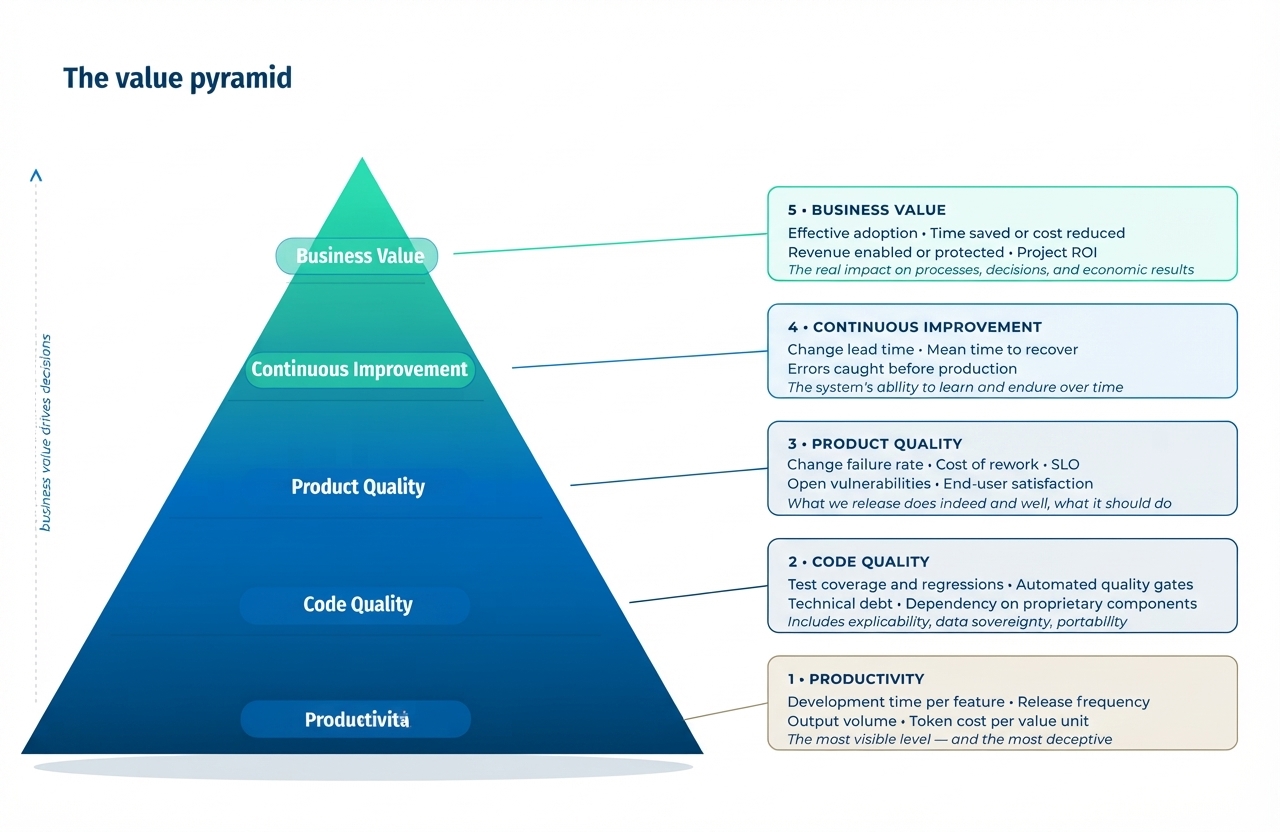
For a company summit, the question becomes very concrete: what do we measure? We can read the metrics that matter as a pyramid, where each level rests on the previous one and none, on its own, is enough. The biggest risk is not going slowly; it's going fast in the wrong direction.
1.Productivity
It is the first level, the most visible and the most deceptive. It measures how long it takes to develop code and with what efficiency, a topic that with AI also includes token consumption, i.e., the computational cost per unit of work produced. It is the most immediate benefit of Agentic Coding, but also the easiest to overestimate, because with AI the volume of what is produced increases almost effortlessly, and producing more does not mean generating more value.
- Development time per feature
- Release frequency
- Volume of output
- Cost in tokens per unit of delivered value
2.Code quality
A level above, the solidity of what we produce is measured, even before releasing it. Here, explainability matters, meaning the comprehensibility of the code for those who will have to work on it again, maintainability and ease of evolution, but also two dimensions that weigh in the decisions of a top management: data sovereignty and portability, meaning the freedom not to be trapped by a single technology or supplier. It is the level that protects the value of the investment over time, because software that no one can evolve quickly depreciates.
- Test coverage and regressions
- Outcome of automatic quality gates
- Weight of accumulated technical debt
- Dependency on non-replaceable proprietary components
3.Product quality
Going up, you measure how much what we release really does, and well, what it needs to do. The dimensions are reliability, safety, regulatory compliance, user experience usability, and responsiveness to functional requirements. It is the level at which quality stops being a technical fact and becomes visible to those who use the software and to those who are accountable to the market.
- Change failure rate — changes that generate an incident or require a rollback
- Cost of rework after delivery
- Adherence to SLOs in operation
- Open vulnerabilities · end-user satisfaction
4.Continuous improvement
The fourth level does not measure the state at a moment, but the system's ability to learn and endure over time. The speed of iteration matters, i.e., how quickly one goes from an idea to a verified release, and the product's resilience, i.e., the ability to absorb errors and changes without degrading. It is the level that distinguishes a living system, which improves with each cycle, from one that ages with each release.
- Lead time for a change
- Mean time to recovery after a failure
- Errors intercepted before production
- Recurring problems actually eliminated, not just patched
5.Business value
At the top is the measure to which all other levels, ultimately, must respond: the real impact on the client's processes, decisions, and economic results. It is the level that brings technology back to its reason for being, because a system can be fast, solid, and resilient and still remain valueless if it does not move an indicator that matters to the business. The pyramid is read from the bottom up: the lower levels must always be monitored, but it is the business value that drives the decisions.
- Effective adoption of the solution
- Time saved or cost reduced in the relevant processes
- Revenues enabled or protected
- Return on investment of the project
1.What is Agentic Coding?
It is agentic software development where people define intent, architecture, and acceptance criteria, while agents handle operational implementation, within very short development cycles and with governance, traceability, and compliance integrated from the start, not added afterwards.
2.What is the Value Orientation of adesso.it?
It means not just delivering software but taking responsibility for the outcomes. It's a change in posture that alters the very nature of the relationship with the customer: from supply to partnership.
3.What is the difference between output and outcome?
The output is what is immediately visible: code, functionality, automation, systems. The outcome is the change that realization makes possible: a faster process, reduced risk, a more timely decision, a lower cost.
4.How is the value generated by Agentic Coding measured?
With a five-level metric pyramid, read from bottom to top: productivity, code quality, product quality, continuous improvement, and business value. The lower levels should always be kept under control, but it is the business value that drives decisions.
FIND OUT MORE
Fill the form
if you would like more details
form version: 1.0.0