Decision-making governance
Makes explicit the truly available options: changing providers, migrating data, modernizing a capability. Answers "what can we still choose".

The map that allows visibility on your IT systems and makes informed decisions. A practice of shared knowledge among IT, business, and suppliers, built hands-on in projects.
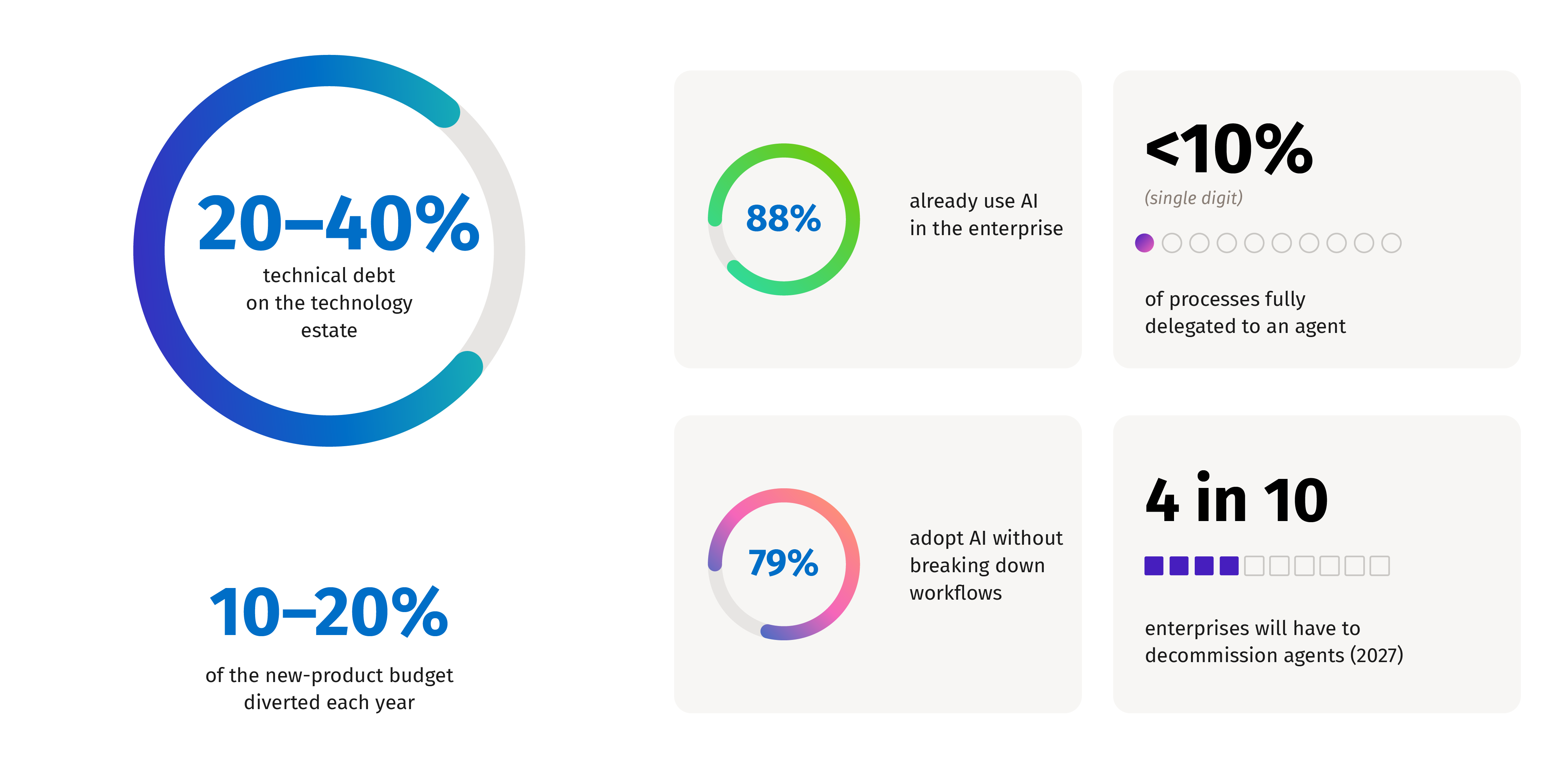
Agentic AI puts Enterprise Architecture at the center because it amplifies a problem CIOs have known for years: no one has a reliable map of processes, data, and suppliers, and technical debt already weighs between 20% and 40% of technological assets. 88% of companies use AI, but less than 10% of processes fully integrate AI agents. When there's a lack of systemic design, the risk moves from being stagnant to having to backtrack on what's already in production.
adesso.it responds by building, together with the client, a Business Capability Map that links investments and business objectives, makes the architecture knowledge explicit, and establishes how much autonomy to grant each agent.
First, we conceptualize the architecture, then we build the system that makes it operational. Enterprise Architecture thus becomes the tool with which the ICT Management governs the information system over time, not a document archived at the end of the project.
On this page you will find:
The information system of a large Italian company almost always tells the same story. On top, recent applications, often cloud-native. Below, a core of systems built in different times, with different technologies, often from different suppliers, held together by integrations that no one fully remembers.
The problem emerges when the whole becomes ungovernable: a CIO can no longer confidently answer simple questions like which processes depend on which systems, where critical data resides, which suppliers have become difficult to replace, how realistically possible it is to change course.
The cost of this loss of visibility is already measurable. CIOs estimate that technical debt represents between 20% and 40% of the value of the entire technological asset, with 10-20% of the budget for new products diverted each year to address it. Less than a third of organizational transformations succeed in improving performance in a lasting way; for digital transformations, the figure drops to 16%.

88% of companies use AI, but less than 10% of processes fully integrate AI agents. If there's no systemic design upstream, there's a risk of backtracking on what's already in production.
Many organizations have invested in training and experimentation, with agents built case by case on ad hoc assembled contexts. That value remains tied to the person who built it and lives in the session of whoever uses it, without becoming organizational capability: 79% of companies introduce AI without systematically deconstructing the workflow to automate, the factor most correlated to the real impact on business results.
By 2027, four out of ten companies will have to revert or deactivate agents already released due to governance issues that emerged only afterward.

For us, Enterprise Architecture does not impose top-down standards: it is a practice of sharing knowledge between ICT Management, business, and suppliers. We extend the traditional boundary of systems and data also to the agents and the decisions they need to be able to make. Our Enterprise Architects are involved from the first introductory and analysis interviews, even before the project takes shape. The role now has a precise goal**:** a person who works within the client’s context from the start, to bring out the real sources of value before designing any solutions.
A dependency matrix that connects processes, data, integrations, suppliers, and skills. If this element changes, how does it impact the business? The technical debt that emerges from this map is not just a risk to flag: it becomes the criterion for deciding what to modernize first and what, instead, is worth maintaining as it is.
We distinguish operational and critical data, clarifying ownership, access, regulatory constraints, and portability — the first step for a credible exit plan.
The work converges into a Business Capability Map, built together with business managers: it sees each initiative not only for its technical benefits but for its effects on flexibility and future decision-making capacity.
This work does not end with the initial design. We maintain observability and control throughout the application life, up to operational management, so that decisions made in run remain consistent with the architecture defined upstream. And we do it piece by piece with a journey built together with the client, coordinating IT’s priorities with the business needs as they emerge.
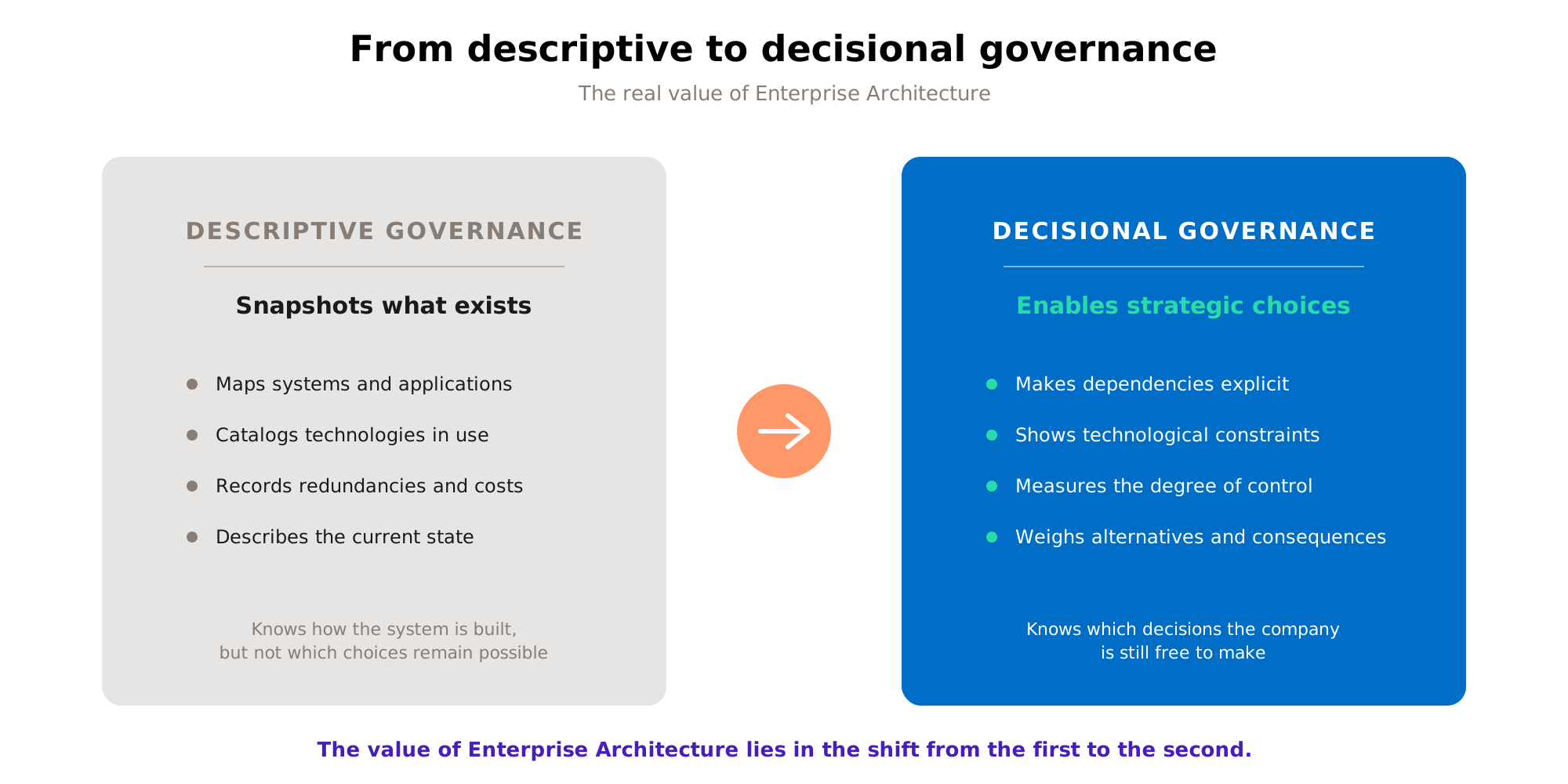
Descriptive governance merely captures the existing: catalogs systems, applications, flows. Decision-making governance is able to enable strategic choices because it makes the truly available options explicit, not just the current state of things.
Makes explicit the truly available options: changing providers, migrating data, modernizing a capability. Answers "what can we still choose".
The issue of sovereignty here assumes a fully operational nature. It is not an abstract or geographic choice, but the same decision-making ability applied to control over data, suppliers, and platforms. It is not an additional constraint to manage but the condition that allows sustaining strategic choices over time. The same applies to AI components: the client maintains full ownership and confidentiality of their strategic data and the cognitive models that process them, not just the infrastructure that hosts them.

Where they reside and who really accesses them.

Conscious management of dependence on each vendor.

Data and applications transferable between different environments.

Visibility over what truly connects the systems.

Awareness of the real price of leaving a platform.

The ultimate measure of the maintained control.
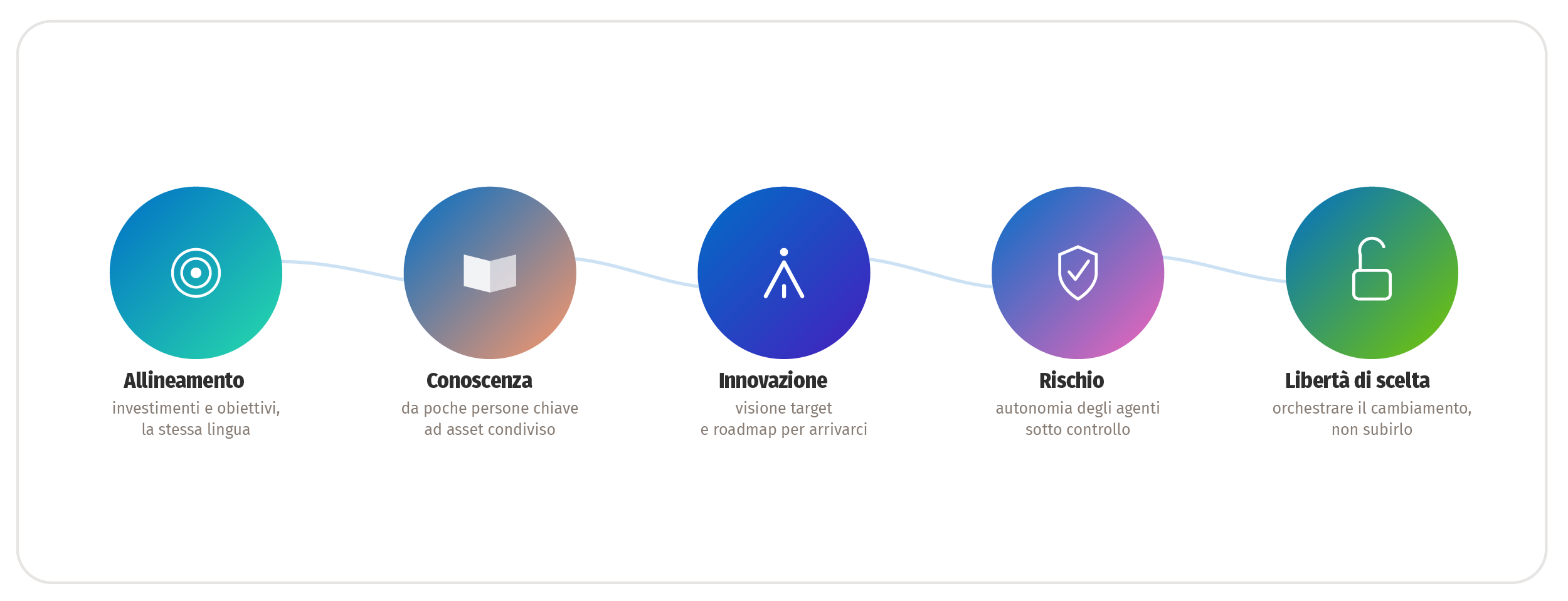
The benefits affect multiple levels of the organization, from alignment between business and IT to the freedom to revise technological choices over time. Here are the main ones:
The Business Capability Map becomes the tool to link each technological investment to a recognizable business objective, not to an isolated project.
The real state of the architecture, often only known to a few key people, becomes explicit and accessible to the entire organization, respecting defined permissions and sharing rules.
A target vision and a roadmap to reach it, so the company has a clear view of its current position, the target to reach, and the roadmap needed to get there.
The map of systems and dependencies allows for distinguishing the level of autonomy granted to each agent and intervening before an incident in production forces it to shut down.
With a shared framework of dependencies, alternatives, and exit costs, the company orchestrates technological changes consciously instead of undergoing them and can review its choices when business priorities change.
How much is the hidden technical debt in your application portfolio worth today?
It's the practice that connects processes, data, applications, and AI agents to measurable business objectives, built together with ICT Management, business, and suppliers: our architects work within project teams, not from a separate study office.
It's the map that connects stakeholders, processes, applications, and data flows to organizational capabilities. It involves the business, not just IT, because only those who own the process know which capability is truly strategic.
Yes, but used selectively. adesso.it only applies models that are useful for the specific client's context, without importing the entire framework, and extends them to include the agents among the elements to be governed.
Through the map of systems, data, and dependencies built by Enterprise Architecture, which distinguishes where an agent can operate with broad margins and where human checkpoints are needed before an incident in production warrants it.
Enterprise Architecture is the operational basis of data sovereignty: classifying data for relevance and mapping vendor dependencies are activities of Enterprise Architecture even before security or compliance.
An audit captures the current state and stops there. adesso.it's approach builds a shared and continuous knowledge base, with hands-on architects in project teams, designed to guide recurring decisions.
Fill the form
if you would like more details