Reduction of lock-in
Those who replace an incumbent supplier face the transition more easily and more cost-effectively: specialized agents reduce the effort of knowledge transfer without eliminating it.

The management of the application portfolio can be seen only as a necessary cost, or it can become the basis of the next transformation.
In most companies, application maintenance proceeds without a single model: knowledge is concentrated in a few people, and the work remains invisible, treated as a cost to minimize rather than an activity to govern.
On this page you will find:
It is an organizational problem before a technical one. In most organizations, there is a lack of a model that governs the entire lifecycle of applications in a continuous and repeatable manner: it proceeds case by case, and this is how two costs form that rarely end up in a business case.
The first concerns the people: those who truly know how a system works are often a handful of individuals, and that knowledge leaves the door with them when their role changes, when the team changes, or when the company changes supplier.
The second concerns the perception: maintenance does not produce demos or releases to announce, so it absorbs budget without generating visible value to the business's eyes, and is often the first item to be compressed when looking to cut costs.
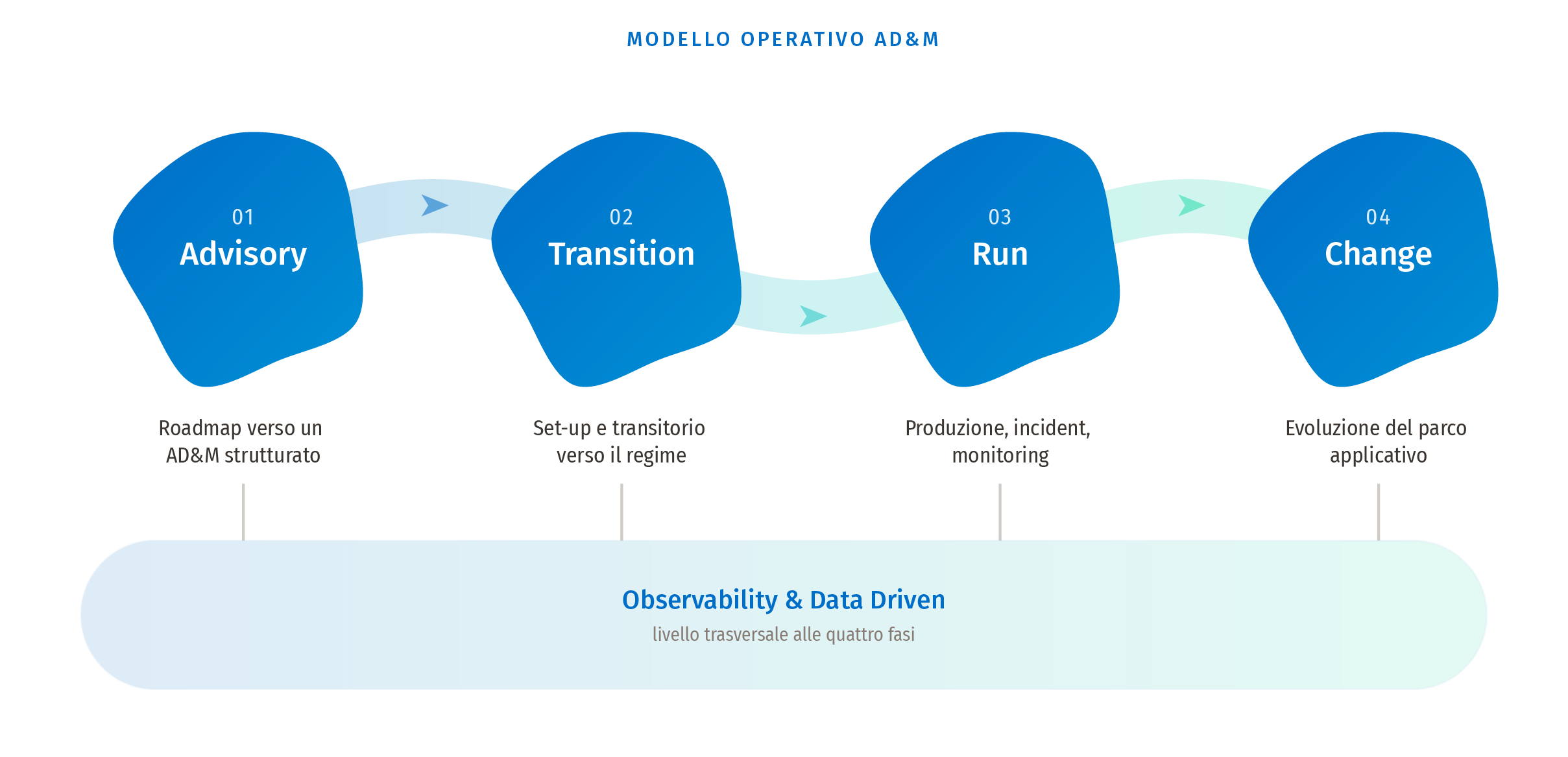
The model is articulated in four sequential phases, supported by a transversal level of observability and a data-driven approach, designed to progressively increase service levels and the reliability of the applications, without replacing human judgment but to make it more effective.
The service is typically activated in two moments.
Post go-live, directly integrated into the project's supply, for a smooth transition from implementation to maintenance and evolutionary support.
Or in replacement, when a company decides to replace an existing supplier, with a planned transition and structured knowledge transfer protocols.
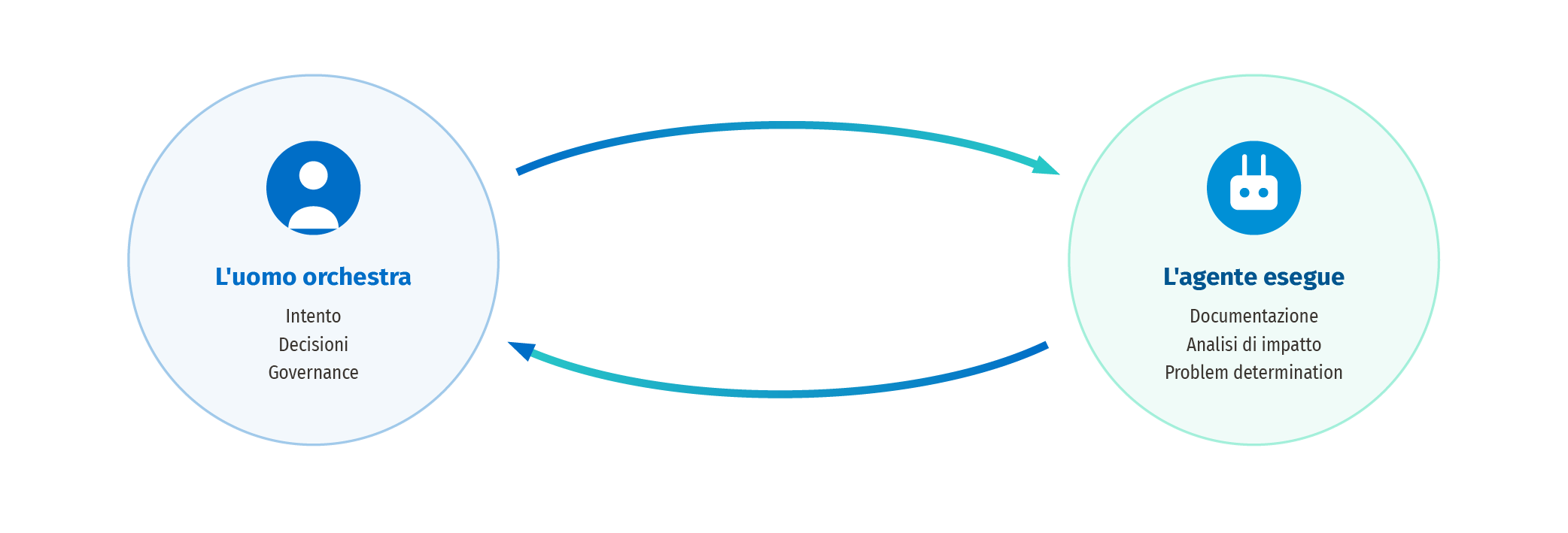
The agent-based work method is applied to the lifecycle following release. The same guiding principle applies everywhere: humans orchestrate, agents execute.
Agent-based management of documentation and code reduces lock-in towards a single supplier, as the knowledge of the application portfolio does not remain only in people's heads. Impact analyses and problem determination rely on a set of agents specialized in the client's specific context, anticipating the most critical incidents before they propagate throughout the entire application portfolio.
The benefits touch five organizational levels, from technical knowledge to the capitalization of the investment over time.
Those who replace an incumbent supplier face the transition more easily and more cost-effectively: specialized agents reduce the effort of knowledge transfer without eliminating it.
Agent-based management of documentation and code reduces the lock-in towards a single supplier: the application portfolio becomes a consultable asset for the entire organization.
Impact analyses and problem determination rely on agents specialized in the client's context, anticipating the most critical incidents.
The monitored KPIs go beyond the basic SLAs: they include monitoring and preventive maintenance, not just responding to incidents that have already occurred.
Maintenance stops being a cost to minimize and becomes an activity that accumulates knowledge and reusable components for subsequent projects: the application portfolio shifts from a cost center to a growth base.
Let's talk about your application portfolio
This is the service with which adesso.it takes charge of the evolutionary, corrective, and adaptive maintenance of a company's custom application portfolio, applying the same agent-based work method used in new development also to the lifecycle following release.
It does not proceed with spot interventions, one ticket at a time: it is a structured operational model in four phases, Advisory, Transition, Run, and Change, with a transversal level of observability and a data-driven approach.
Evolutionary maintenance when the business changes, corrective when something breaks, adaptive when the underlying infrastructure evolves.
In two typical moments: post go-live, integrated into the project's supply, or in replacement, when a company replaces an existing supplier.
Three: fixed capacity, shared service with co-managed governance, or closed service with fully contracted KPIs and SLAs. The choice depends on how much operational governance the company wants to maintain in-house.
Every AD&M project carries the context built with Context Engineering: business capability map, corporate knowledge graph, verification harness, acceptance criteria. The context does not live in the head of the single team but in the work method, and every new team starts from there.
Fill the form
if you would like more details