
Our work method is flexible and surpasses the limits of binding platforms. Based on the specifics of each project and client, we assemble the most suitable workflows, employ the most effective artificial intelligence models, and adopt the best software engineering practices. This combination is dynamically adapted to the client's organizational structure and governance models. The theoretical and practical foundation is primarily derived from adSCAILE, the agent-based software development process of our group adesso SE, inherently independent of the underlying technologies.

Insights1/10/2026
How we work
We combine Agentic AI with our working method to amplify the value generated for clients.
What will this page talk about
Our work method supported by Agentic Coding for enterprise software development, where AI agents write and execute code under the guidance of developers who define objectives, constraints, and verification criteria:
- The pillars of Agentic Coding: human responsibility, value over speed, governance by design, state-of-the-art engineering.
- The elements of the work method: 6 elements that allow us to build and assemble the most suitable workflows, employ the most effective artificial intelligence models, and adopt the best software engineering practices tailored for each client, to their needs and their governance style.
- The impacts of Agentic Coding: executive layer and situational layer to understand where AI accelerates and where humans remain fundamental. A real case is contained with objective metrics that measured the change.
- Traditional coding vs agentic coding in the project phases: how the weight of the five iterative and cyclical phases of a project changes when Agentic Coding comes into play.
A new era of software engineering
Since its origins, software development has been a human profession. Today it becomes a shared work with AI agents, who write and execute the code while developers define objectives and constraints, in alignment with the client's context and business needs. Roles change accordingly: mastery shifts from coding, increasingly delegable to agents, to the ability to instruct and verify systems that work autonomously. Smaller teams are born, capable of producing more, focused on the result for the client and not on the hours to report.
The pillars of Agentic Coding
1.Human responsibility
Agentic AI can perform, but does not decide what is acceptable, because intent, risk, and responsibility remain the prerogatives of people. It is up to humans to make strategic decisions and ensure that technology generates real, ethical, and business-aligned value.
2.Value before speed
Acceleration only matters when change does not increase risk and brings measurable real business value. Productivity is closely tied to reducing Time to Value without compromising quality and evolvability.
3.Governance by design
Traceability, verifiability, and control are a structural part of the way of working from the beginning, so that you can always reconstruct why a decision was made.
4.State-of-the-art engineering
A method of agentic work development, adapted to the specific organizational context of each reality and constantly updated to the state of the art, to avoid sticking to practices that the market surpasses in just a few months.
Our working method
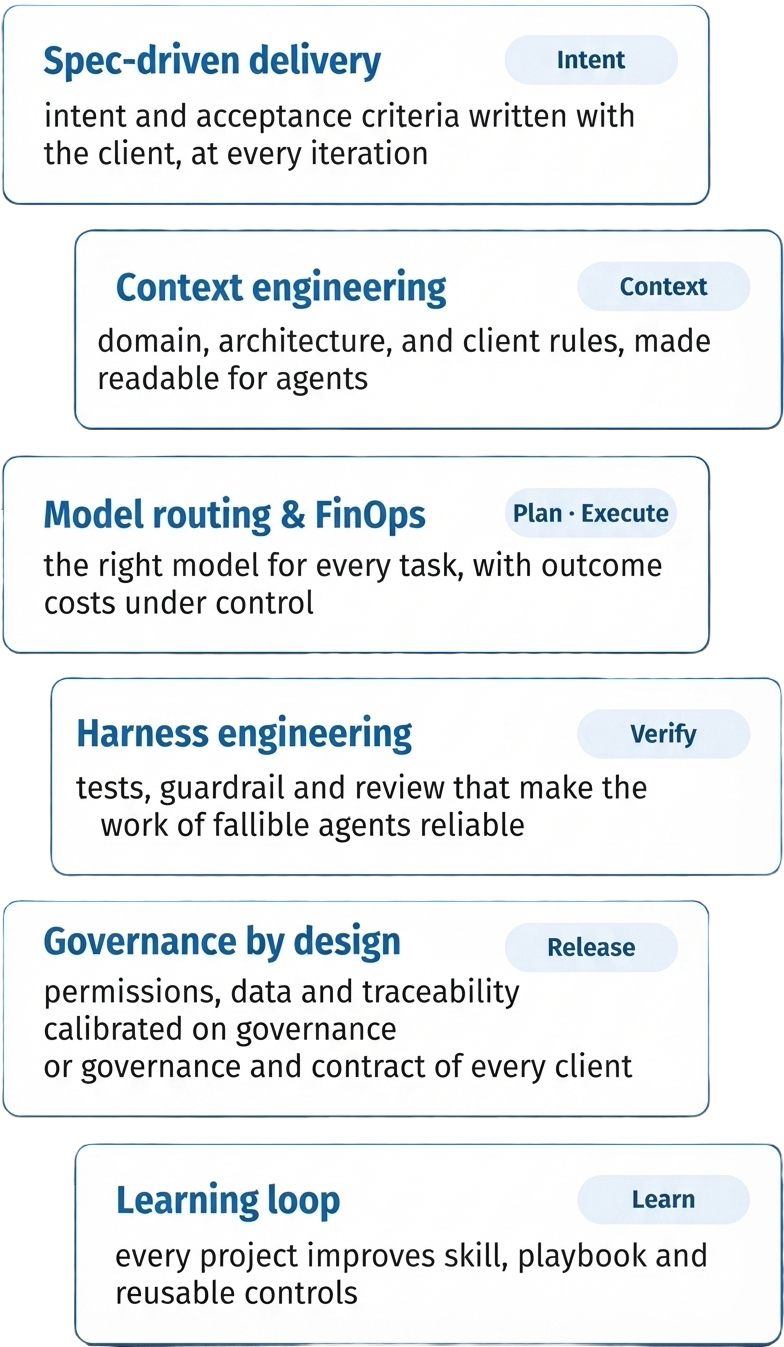
Our asset lies in the working method that allows us to adapt workflows and the most suitable agentic development processes for each client and project, taking advantage of technological evolutions. These are the 6 elements of the method of adesso.it:
- Spec-driven delivery: in each iteration, we define objectives, constraints, and acceptance criteria together with the client, written in a form that is readable by both people and agents.
- Context engineering: an agent works well only if it truly knows the client: their domain, their application architecture, their business rules, their regulatory constraints. We structure this knowledge in a form that can be queried by agents so that each iteration starts from the client’s real context, not from a generic model.
- Model routing and FinOps: there is no single right model for everything. In the planning and execution phases, we route each task to the most suitable model, by capability and cost, instead of always using the same engine for everything. The resulting control is not over the cost of a single inference but over the cost per outcome: the metric that makes the scalability of the project sustainable over time.
- Harness engineering: agents are powerful but fallible: verification is the phase on which we invest the most engineering and time. We build a harness of automated tests, guardrails, and human review checkpoints that intercept errors before they reach production. This is what makes reliable work that, by its nature, is born non-deterministic.
- Governance by design: permissions, data management, and traceability of decisions are designed from the outset, calibrated on the governance model, contract, and sovereignty requirements of each individual client. This is what allows a solution to move from a controlled environment to real use in production, without surprises along the way.
- Learning loop: each iteration leaves something in legacy for the next: skills, playbooks, reusable controls. We close the cycle by collecting what worked and what didn’t, bringing that learning into the following project. Thus, our working method improves with each iteration.
The working method is cyclical and iterative, divided into 7 phases: Intent, Context, Plan, Execute, Verify, Release, Learn. We can return to the previous phase at any time: it is our agile approach, based on continuous iteration cycles together with the client.
The impacts of Agentic Coding
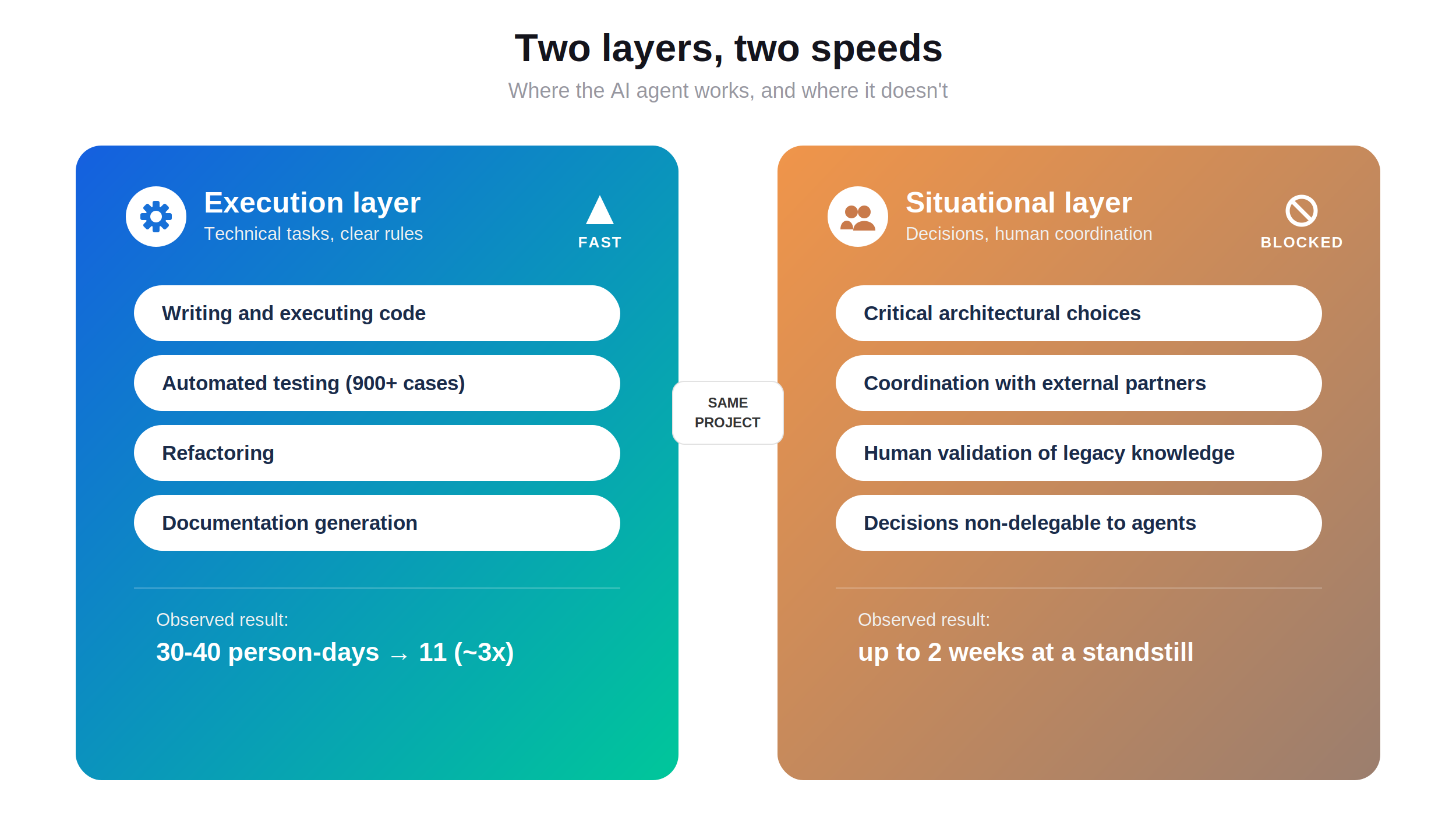
Agentic Coding produces acceleration on closed and verifiable specific activities autonomously by agents: writing and executing code, front-end and back-end testing, refactoring on known patterns, documentation generation. We call this type of activity execution layer.
The same acceleration is not recorded in all activities requiring context: architectural decisions with cross-impact, human validation of knowledge extracted from legacy systems, coordination with external partners. We call this other type of activity situational layer.
A real case documented by adesso.it, an enterprise project in the education sector on a brownfield basis, shows the difference in numbers: the infrastructure setup estimated in 30-40 man-days was completed in 11 man-days, with an acceleration of about 3 times, and over 900 test cases were written and executed from the start of the project, while two weeks of development remained stalled waiting for a decision on the external partner side, not due to a technical limit. The lesson is clear: gaining speed in the execution layer makes sense only if the situational layer directs it in the correct direction. Otherwise, the risk shifts further ahead, where correcting it costs more. Added to this is a second dimension of benefits: higher software quality because objectives, constraints, and verifications are explicit from the first line of code, full traceability of decisions even months later, reusable context on subsequent projects, and governance firmly in the hands of the people.
Traditional Coding VS Agentic Coding in the phases of the project
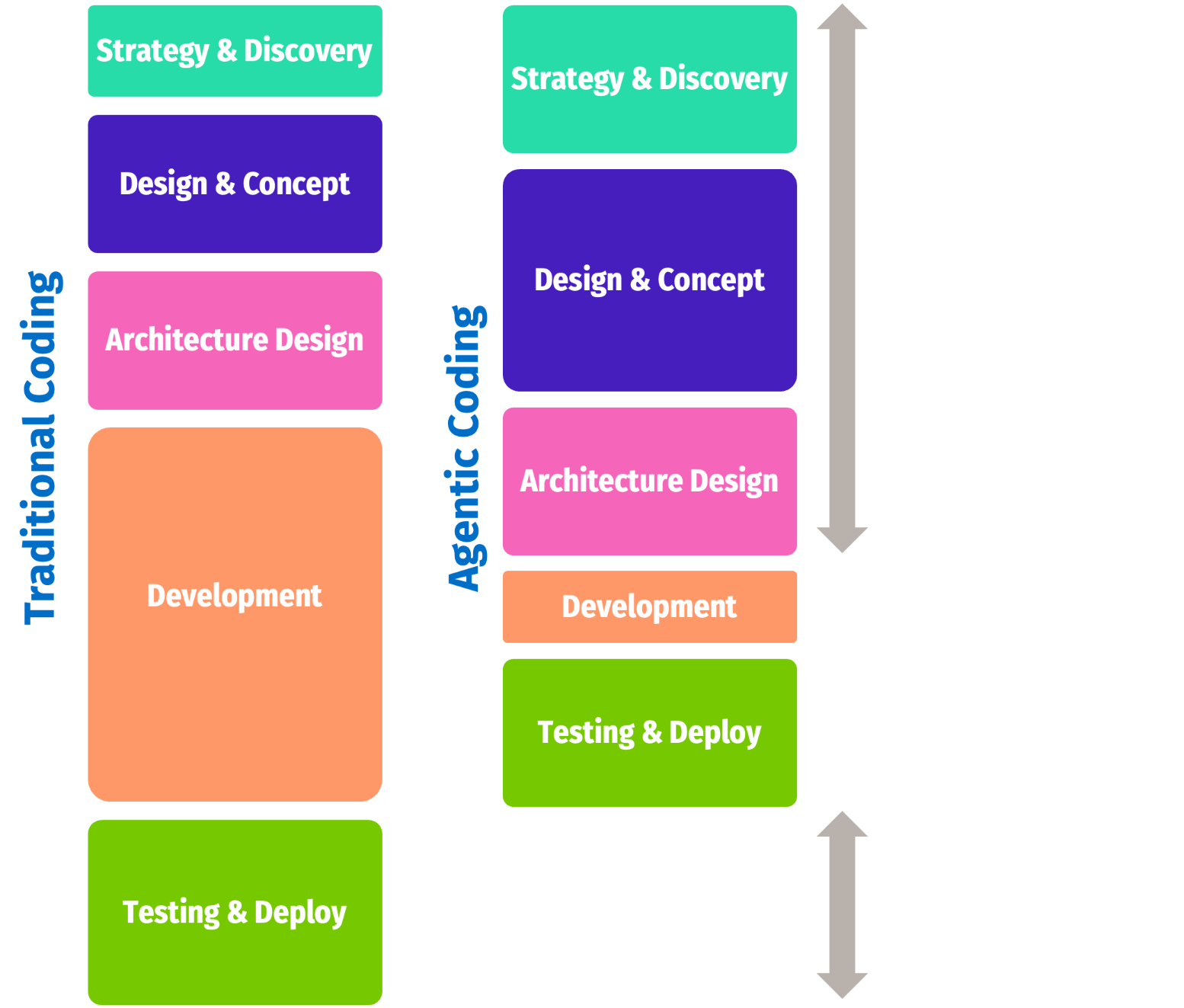
The distinction between the executive and situational layers explains how the weight of the five standard phases of a project changes when Agentic Coding comes into play. Previously, the five macro-activities maintained a relatively balanced weight; now the balance changes asymmetrically.
- Strategy and Discovery belongs entirely to the situational layer and becomes even more crucial: in an era of abundant technical solutions, understanding what the priority problem to solve is counts more than knowing how to build it, and this choice cannot be delegated to agents.
- Design and Concept remains in the situational layer and retains all its weight: without solid design, elegant solutions risk being centered on the wrong need.
- Architecture Design lives on the threshold between the two layers: agents support the production of diagrams and the evaluation of alternatives, while decisions with cross-impact on the application landscape, security, and data model remain governed by people.
- Development is the properly executive phase, where acceleration is more visible with an additional cost linked to AI tokens and quality and security standards that remain high.
- Testing and Deploy also lives on the boundary: AI supports the generation and execution of tests well, but precisely because the code is generated by AI, validation requires an even more structured process, where human judgment on what to verify thoroughly remains decisive.
adSCAILE: the software development process of the adesso SE Group
Our working method is theoretically and practically based primarily on adSCAILE, the agent-based software development process developed by the adesso SE group and independent of technologies. We share its fundamental idea: value does not lie in a tool to install, but in a structured process, from architecture to operational cycles lasting two to four days, up to continuous exercise.
Among the tools of the Group that we can employ is adesso AI Hub, the tool that allows addressing issues related to digital sovereignty, ensuring access both to the most advanced commercial models and to local and open-weight instances, with the availability of a transparent dashboard for real-time token consumption.
Strengthening the process is the partnership with Anthropic formalized in August 2026, which places adesso among the first Select Partners of the Claude Partner Network worldwide, with over 200 experts from the Group on a certification path as Claude Certified Architect Foundation and privileged access to Claude and Claude Code models.
Our principles in agent development are based on a solid and shared industrial foundation, while we choose agent workflows, case by case, for each client.
CONTACT US
fill out the form
to get in touch with us
form version: 1.0.0