
Insights14/7/2026
Application modernization in the era of Agentic AI
Article curated by

Massimo Ficagna
Business developer

Technical debt as a transversal risk for business
Every company with a consolidated application heritage eventually faces the same dilemma: the systems that have supported business growth for years become, over time, the main hindrance to its evolution. It is not an isolated technical problem, but a transversal risk that crosses security, compliance, costs, and the ability to innovate. The accumulated technical debt, loss of internal know-how, platform obsolescence, and the end of vendor support expose organizations to concrete vulnerabilities; at the same time, poor maintainability and limited scalability, both technically and team-wise, slow down time-to-market and create functional gaps compared to the competition. Added to this is a less visible but equally costly effect: the stratification of software over time, combined with the difficulty in finding qualified personnel for outdated technologies, progressively increases operating costs, while the rigidity of legacy systems limits access to emerging technologies and crystallizes an outdated user experience.
A 2025 study by the Digital Innovation Observatories of the Politecnico di Milano on 69 large Italian companies found that 39% of the application landscape requires modernization interventions.
The question, therefore, is no longer whether to modernize, but when and how to do it.
The three modernization strategies: repurchase, lift&shift, and application modernization
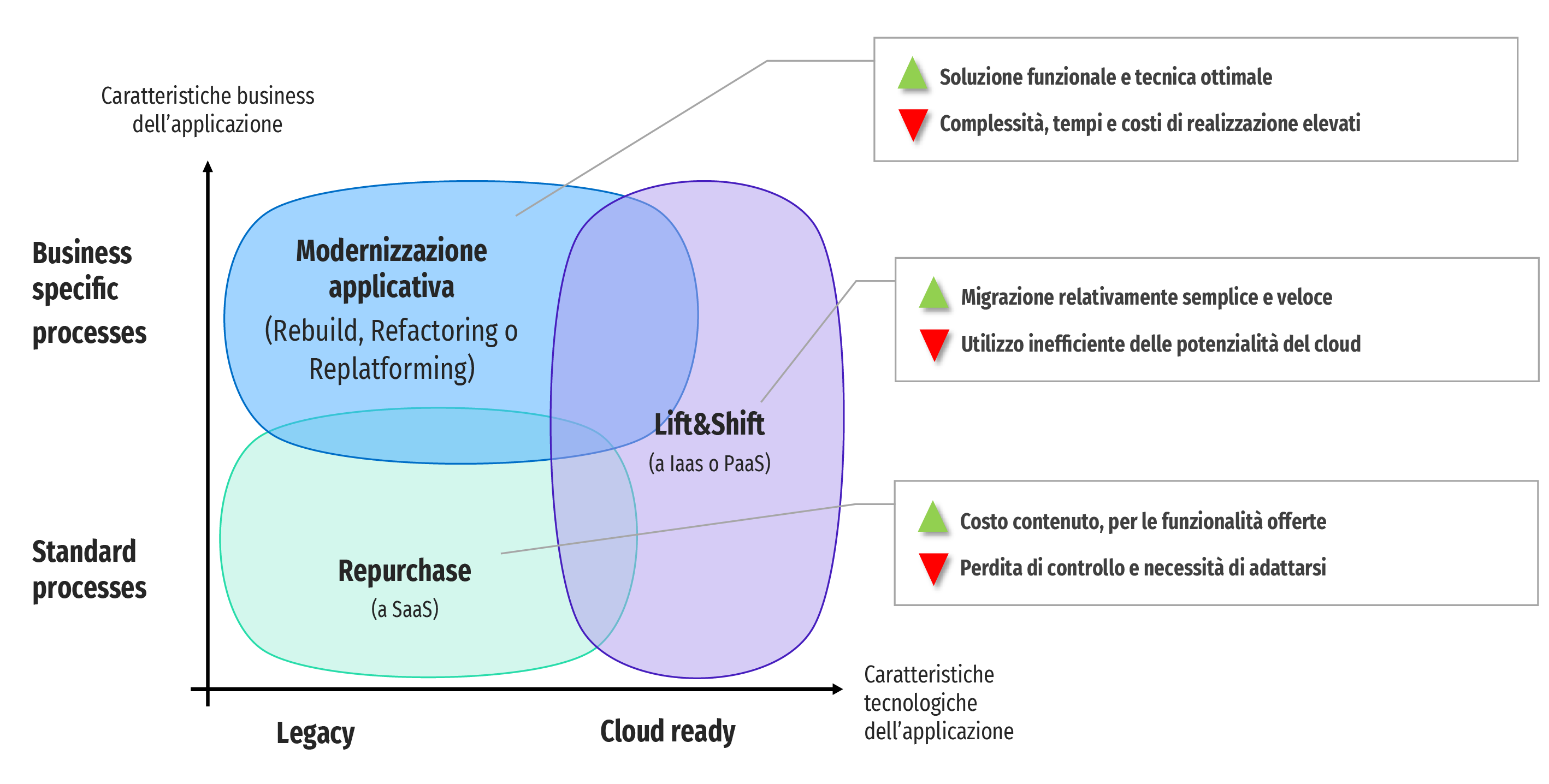
When faced with a legacy application, organizations typically have three paths to choose from, and the choice depends on two variables: how specific the application is to the business in relation to standardizable processes, and how ready its technological infrastructure is for the cloud.
When processes are highly standardizable, repurchasing SaaS solutions offers a low cost in exchange for available functionality but results in a loss of control and the need to adapt to product constraints. When the architecture is already cloud-ready, lifting and shifting to IaaS or PaaS allows for a relatively quick migration, although it often inefficiently utilizes the cloud's potential. But when the application supports specific business processes and still has a legacy technological footprint, the real leverage is application modernization: the most complex path in terms of time and cost, but the only one capable of producing a functionally and technically optimal solution for the business.
How Agentic AI changes make-or-buy decisions in application modernization
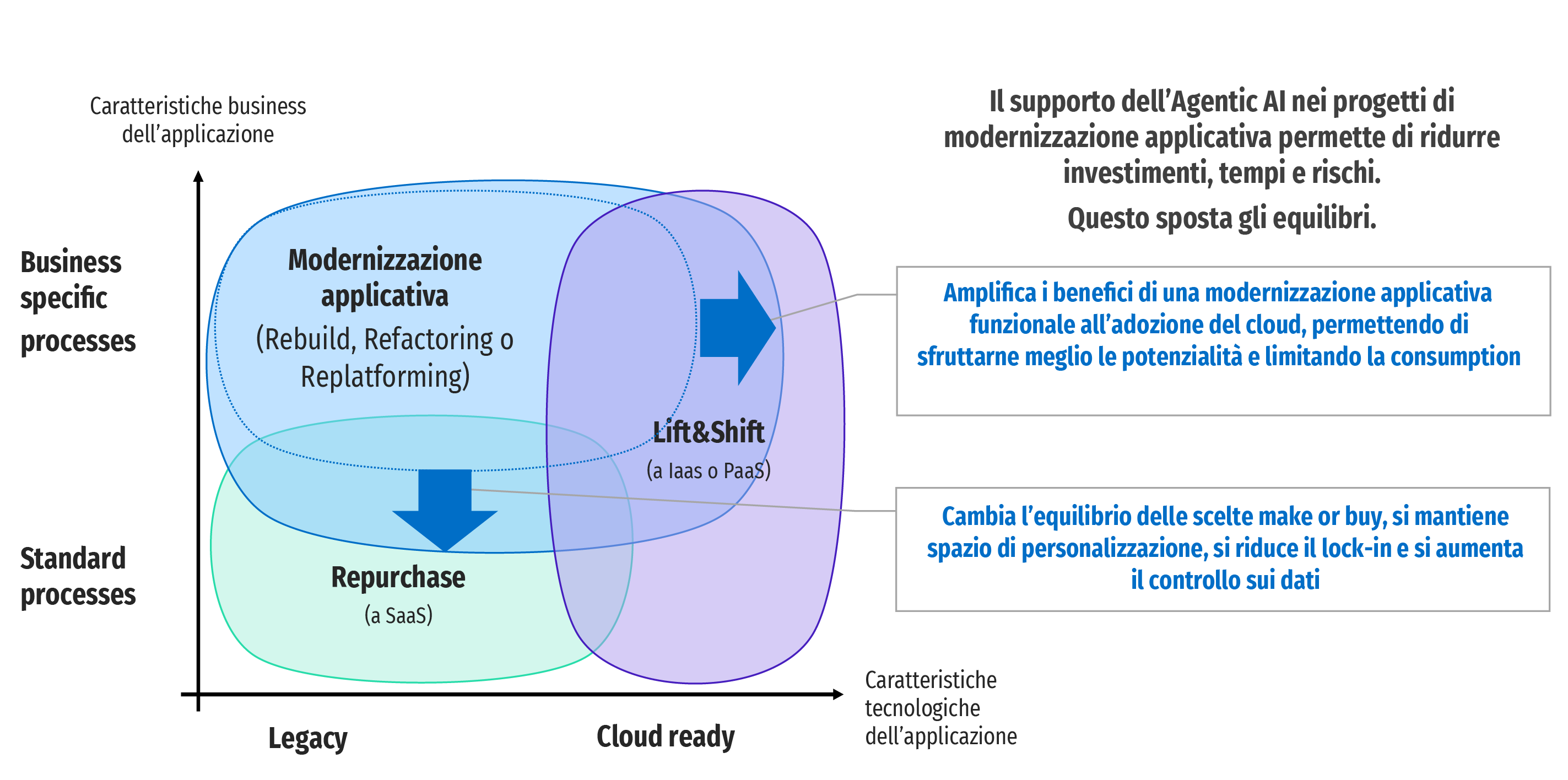
It is here that the picture is changing substantially. The introduction of Agentic AI in application modernization projects reduces investments, time, and risks, effectively shifting the make-or-buy decision balance: application modernization becomes more accessible even where cost would previously have favored a packaged solution, while maintaining customization space, reducing vendor lock-in, and increasing data control. At the same time, Agentic AI amplifies the benefits of modernization conducive to cloud adoption, allowing better exploitation of its potential and limiting consumption. It is therefore not just a productivity tool, but a factor that redefines the relative attractiveness of different transformation strategies.
The four methodological challenges of application modernization
Those who have led large-scale modernization projects know that the greatest risk is not technological but methodological. Four factors determine the success or failure of a transformational journey.
The first is rediscovering the legacy system: recovering knowledge, often dispersed or never documented, about functionalities, business logic, application organization, data models, technological stack, and interdependencies. In the initial analysis phase, a general understanding of these aspects is sufficient to steer strategic choices; specifics are deepened along the way.
The second is slicing the elephant: to manage complexity and minimize risks, a monolithic legacy application must be decomposed and modernized progressively, carefully identifying where to cut ties between components.
The third is changing the engine in-flight: the system must continue to function while being transformed. This requires solidness, with rigorous pre-release testing on quality, non-regression and security, and reliable rollback procedures; coexistence between new and legacy functionalities; and canary releases, with progressive rollout on users and parallel operation periods under controlled monitoring.
The fourth is managing change over time: the modernization of large-scale core business applications is not a project with a defined end, but a continuous journey that must embrace new business needs, regulatory changes, and unforeseen events. A roadmap is useful as a reference, but the real difference is made by a governance capable of adapting the path without generating entropy or losing control.
The four-phase method for modernizing a legacy system
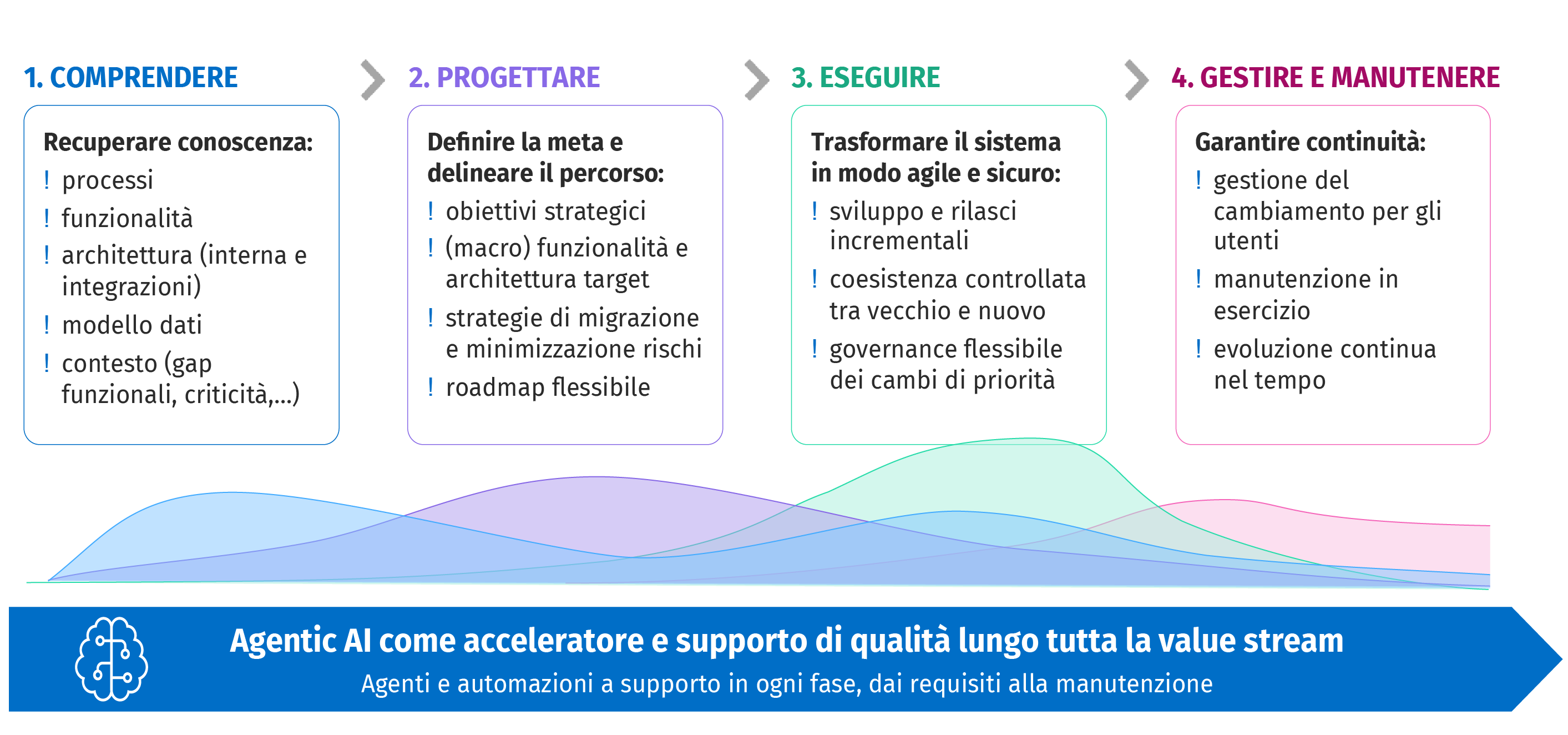
To govern this complexity, a structured approach is needed, articulated in four iterative and partially overlapping macro-phases: understanding, designing, executing, managing, and maintaining.
Understanding means recovering knowledge of processes, functionalities, internal architecture, integrations, data model, and context through structured interviews with business, key users, and IT, supported by AI analysis of source code, databases, documentation, and logs, with cross-validation to bridge the gap between perception and reality. Designing means defining the goal, capability map, target architecture, modernization strategy, and roadmap through workshops with the business and discussions with IT management. Executing means transforming the system in an agile and secure way, with incremental development and releases, controlled coexistence of old and new, flexible governance, and a solid foundation of metrics, KPIs, and test strategy. Managing and maintaining finally means ensuring continuity over time, accompanying the change for users and ensuring the continuous evolution of the modernized system.
Agentic Coding: the supervised agentic development cycle of adesso.it
Throughout this value stream, the model that we at adesso.it call Agentic Coding acts as an accelerator and quality guardian, with agents and automations supporting every phase, from requirements to maintenance: a supervised agentic development cycle always overseen by an expert team, capable of reducing service disruptions, improving time-to-market for functional evolutions, supporting continuous technological evolution, preserving knowledge, and facilitating resource rotation.
It is worth remembering that the very concept of legacy is a moving window: technological innovation does not stop, and what is modern today will in a few years become obsolete, if a development cycle capable of ensuring the continuous evolution of the new system is not organized.
Concrete cases of modernization with Agentic Coding
These principles are reflected in concrete projects: from replacing an e-learning SaaS platform with a custom solution developed by a small team assisted by AI agents, with one-day sprints; to the modernization of a mobile banking platform, migrated from a Java EE monolith to Spring Boot microservices and Kafka on Kubernetes, enabling new business services from the first production releases; to the transformation of a B2B/B2C e-commerce and back-office platform with over three million lines of code, with a virtual data model to ensure real-time alignment between the old and new system, without significant service disruptions.
Technical debt from risk to competitive leverage
The common thread of these projects is always the same: application modernization is not a one-time technical operation, but an organizational capability to build, where technology, increasingly powered by Agentic AI, is put at the service of a solid methodology, flexible governance, and constant control over quality, security, and speed. Organizations that can build this capability will transform technical debt from risk to competitive leverage.
Frequently Asked Questions
1.When is it better to modernize a legacy system instead of replacing it with SaaS or migrating it in lift&shift?
The choice depends on two variables: how much the application is specific to the business compared to standardizable processes, and how ready its technological framework is for the cloud. If the processes are standardizable, a repurchase towards SaaS is more convenient. If the architecture is already cloud-ready, lift&shift allows for a quick migration. However, if the application supports business-specific processes with a legacy technological footprint, application modernization is the only tool capable of producing a truly optimal solution.
2.How does make-or-buy change with Agentic AI?
Agentic AI reduces investments, time, and risks of application modernization, making it more accessible even where in the past the cost would have leaned towards a packaged solution. It maintains customization space, reduces vendor lock-in, and increases control over data, redefining the relative convenience of different transformation strategies.
3.What is Agentic Coding?
This is the term adesso.it uses to define an agentic development cycle that is always supervised by an expert team, where agents and automations support every phase, from requirements to maintenance. It allows for the reduction of service disruptions, improves the time-to-market of functional evolutions, supports continuous technological evolution, preserves knowledge, and facilitates resource rotation.
4.What are the four methodological challenges of application modernization?
Rediscover the legacy system, recovering knowledge often dispersed or never documented; slice the elephant, breaking down the monolith into progressively modernizable components; change the engine in flight, maintaining the operating system while it is being transformed; manage change over time, with governance capable of adapting the path without generating entropy.
5.What are the four phases of the application modernization method?
Understand, design, execute, manage, and maintain. These are iterative and partially overlapping macro phases: starting from recovering knowledge on the existing system, defining the target architecture and roadmap, transforming the system with incremental releases and controlled coexistence between old and new, and ensuring continuity and evolution over time.
Bibliography
Osservatori Digital Innovation, PoliMi School of Management (Politecnico di Milano), 2025 research on a sample of 69 very large Italian trend-setting companies. www.osservatori.net